





Secret tools and hacks
How To Set Social Media Goals For Every Profile You Manage
More followers, more engagement, more traffic: vague goals like these are easy to set and impossible to act on. Here's how to set measurable social media goals tailored to each profile you manage.

Table of content
With multiple social media profiles to manage, it can be tempting to lump everything under one generic goal: more followers, more engagement, more website traffic. But while those metrics might sound good in theory, they’ve got to get far more specific and aligned to broader business goals before they can be effective.
If your Instagram is focused on community-building, your TikTok is all about top-of-funnel visibility, and your LinkedIn is there to drive leads, should they really all be chasing the same outcome? Short answer: no.
In this article, we’ll walk you through how to set more strategic, measurable, and purposeful goals for each social channel you manage in your social media marketing strategy.
We’ll explore how different platforms serve different functions in your broader marketing ecosystem, how to use a proven framework to set better goals, and how to use tools like Iconosquare to stay on track.
Let’s dive in.
Why one goal across every profile dilutes your strategy?
Every social platform serves a different purpose and a different audience in your social media strategy.
Your community on Instagram may love day-in-the-life Reels and brand storytelling, while your LinkedIn audience leans into thought leadership and professional insight. Your Pinterest followers are likely searching for inspiration and as for TikTok viewers, they’re after short, entertaining content that educates or inspires in under a minute.
So, it makes sense that your social media marketing strategy – and your goals – should reflect those differences.
Setting the same goal across every account not only dilutes your strategy. It also makes it nearly impossible to measure what’s working and what isn’t.
When you define what success looks like per platform, it becomes much easier to:
- Assign ownership and accountability, especially across larger or distributed teams
- Report on performance in a way that’s aligned with your broader marketing objectives
- Know when to pivot, double down, or iterate on what’s working, and then reduce social media efforts
- Prove return on investment (ROI) to your wider team or leadership, especially when multiple departments are involved
It also gives your content a clear sense of purpose – something that’s increasingly important when attention spans are short and competition is high.
And when you’re juggling five, ten, or more social profiles? This clarity becomes non-negotiable.

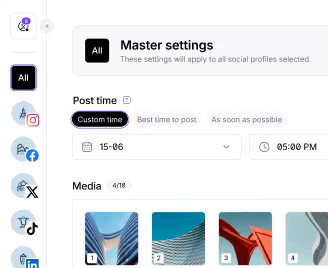
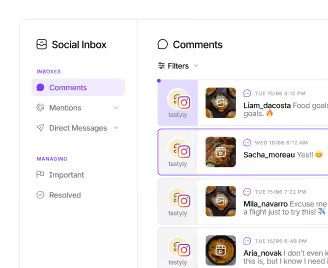
Iconosquare makes it easy to track several social media profiles at once.
What makes smart social media goals measurable?
While there’s no one-size-fits-all answer, first, consider the brand’s broader business objectives. These could include sales, new hires, customer retention, lead generation, and brand awareness.
Once you know this, you can create social media goals that align with these objectives.
But before locking anything in, run each goal through the SMART framework. That means checking it’s:
- Specific
- Measurable
- Achievable
- Relevant
- Time-bound
SMART goals aren’t just a planning formality. They’re how you make sure your goals are realistic, actionable, and aligned with your business’s bigger picture.
Social media goals examples by platform
Here’s how SMART social media goals might look in practice:
- Instagram: Boost community engagement by 20% in the next month to deepen community connection and spark more two-way conversations
- LinkedIn: As part of your social media objectives, generate leads through lead-gen content by collecting 100 email sign-ups monthly, including contact details like names and email addresses, to support sales outreach and pipeline goals
- TikTok: Double average views per video over the next two months to grow brand awareness among Gen Z audiences
- Facebook: Achieve a 90% response rate to comments and DMs within 2 hours, while improving response time, resolution rate, and customer satisfaction to strengthen brand reputation and customer loyalty
- Website traffic: Drive website traffic by increasing link clicks by 30% this quarter from campaign posts and profile links
Each of these social media marketing goals ties to a clear purpose and includes a benchmark or timeframe to help measure impact.

Iconosquare’s colorful, detailed reports are extremely helpful when setting (or re-setting) goals.
How to choose the right social media goals for each platform?
Start with the platform's role
Start by asking the big question: what do we want this platform to do for us?
Maybe Instagram is your brand’s behind-the-scenes stage, where you humanise your voice and connect with loyal fans. Facebook could be a frontline for community support and product education. LinkedIn might serve to position your team as thought leaders in the space. TikTok? That could be your gateway to younger, trend-savvy audiences who crave fast-paced storytelling.
If you know each platform’s role, you’ll know what success should look like.
Review your past performance and competitors
Then dig into the details:
- Review your past performance to set a baseline. Identify the key metrics you already track, including engagement metrics like comments, shares, saves, and total engagement rate. What’s your current average engagement rate? Where are your traffic sources coming from, and what does Google Analytics show about website traffic and conversions from social?
- Look at your competitors. What kinds of goals might they be prioritising? What can you reverse-engineer from their results, and how can social media analytics and social media data help you measure brand awareness through tracked brand mentions and other brand awareness metrics?
- Understand what your target audience cares about on each platform. A carousel might work well on Instagram, but your LinkedIn audience may prefer long-form posts. User generated content can also be a strong signal here, and it boosts engagement rates by 28%.
- Align with internal departments. What do sales, support, or product teams need from social media? How can you support their goals with your content?

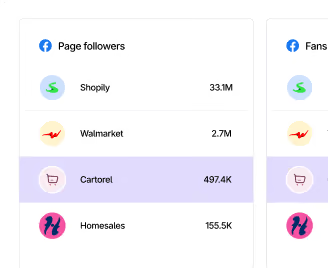
Using Iconosquare’s social listening and monitoring tool to analyze competitors and help me understand how I could improve my own content.
Need an extra lens for goal-setting? Try the funnel filter.
Top-of-funnel, mid-funnel, and bottom-funnel social platforms should have different social media objectives based on how users interact. Top-of-funnel platforms like TikTok or Pinterest might focus on reach, awareness, and content discovery. Mid-funnel platforms like Instagram or YouTube could track things like saves, shares, link clicks, and other engagement-focused key performance indicators. Bottom-of-funnel channels like LinkedIn might zero in on leads, sign-ups, or demo requests.
Still stuck? Ask: What would success actually look like here?
Would it mean more email signups? More demos? A stronger community? Once you know that, you can work backwards.
And if you’re managing multiple platforms at scale?
Consider assigning each one a specific role in your customer journey so you’re not spreading the same content thin across every channel. Focus on 2 to 3 primary goals per quarter.
The goal isn’t to track everything – it’s not to chase vanity metrics, but to focus on the few things that really matter, based on that platform’s strengths and role in your strategy.
How to track your social media goals in one place?
Setting the right goals is only the beginning. The real power comes from tracking them consistently, identifying what’s moving the needle through clear key performance indicators, and being able to adapt quickly.
That’s where a tool like Iconosquare can transform how you manage your goals across multiple social profiles and support broader social media management.
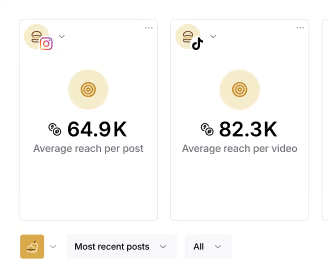
With Iconosquare, you can access platform-specific dashboards built on social media analytics and organized social media data to give you clarity and precision. Whether you’re tracking Instagram engagement, Facebook impressions, LinkedIn CTR, or TikTok views, it’s all right there – accessible, comparable, and exportable.
You can:
- Monitor engagement, reach, impressions, follower growth, and more – customized by platform
- Compare performance across profiles to spot trends or anomalies
- Build tailored dashboards for your specific KPIs
- Schedule and automate reports so your stakeholders stay informed
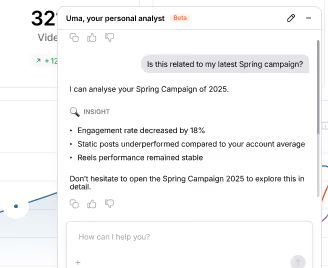
Iconosquare also lets you drill down into individual social media post performance, uncovering what type of content resonates and what flops. Instead of guessing, you’re working from solid insights that support smarter, data-led decisions. That includes engagement metrics such as comments, shares, saves, and total engagement rate.
And because everything lives in one clean, intuitive interface, you don’t have to waste hours jumping between apps, spreadsheets, or manual reports. That gives social media managers a clearer view across social media platforms and paid ads without overvaluing vanity metrics. That’s more time spent fine-tuning your strategy – and less time stuck in admin mode.
Set better social media goals with Iconosquare
If your social media profiles are all chasing the same vague outcome, it’s time to hit pause and rethink your approach.
Each channel is a unique asset in your marketing toolkit. Define what social media success looks like for each one, set measurable goals that align with platform strengths, and use a tool like Iconosquare to track and refine as you go.
You can sign up for a free trial today. No credit card required.
%201.svg)

%201.svg)
%201.svg)